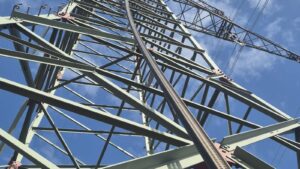
A mobile anchor point is a key element of personal fall protection equipment (PPE) and determines life and safety when working at heights. Anyone who regularly works on power pylons, wind turbines, roofs, or telecommunications towers knows the problem: a permanent anchor point is not available at every work site. This is precisely where the mobile anchor point comes into play, providing a flexible, standards-compliant, and quickly deployable safety solution.
What is a mobile anchor point?
A mobile anchor point is a portable anchor device used to secure people, tools, or loads against falls. Unlike permanently installed anchor points, it can be used at different locations and removed after the work is completed. This makes it particularly suitable for service work, maintenance operations, and temporary construction sites where a permanent solution is not economically viable.
The legal basis for the use of mobile anchor points is the standard. EN 795 Type BIt defines the requirements for portable anchor devices, particularly regarding load-bearing capacity, fastening options, and testing criteria. Devices that comply with this standard reliably withstand dynamic loads and meet the requirements of DGUV Regulation 112-198 as well as the requirements of the Swiss National Accident Insurance Fund (Suva).
Application areas for mobile anchor points
Mobile anchor points are needed wherever work at height takes place under changing conditions. Typical applications include:
- Power grid operation: Maintenance of high-voltage pylons at 50Hertz, Swissgrid or TenneT, where flexible securing points are required on the pylon crossbeam.
- Wind energy: Service work on the nacelle, rotor blades or tower, where different attachment points are required depending on the position.
- Telecommunications: Antenna installation and maintenance of mobile communication sites where the attachment point is fixed to the mast or platform.
- Industry and building technology: Cleaning and maintenance of roofs, facades, crane equipment and systems.
- Construction: Temporary securing of workplaces on construction sites, for example during roofing or steel construction work.
Requirements for a standard-compliant mobile anchor point
For a mobile anchor point to provide reliable protection in an emergency, it must meet strict technical requirements. The most important criteria are:
- Static strength: A minimum load capacity of 12 kN for three minutes is required for anchor points according to EN 795 type B.
- Dynamic testing: The point must withstand a simulated fall with a test mass of 100 kg without failure.
- Material and corrosion protection: High-quality aluminum or steel alloys ensure durability and weather resistance.
- Tool-free assembly: Quick installation without special tools saves valuable operating time.
- Light weight: Mobile anchor points must be easy to transport to the deployment site, ideally weighing less than 10 kg.
- Clear labeling: The CE mark, test number and manufacturer's information must be legibly affixed.
HighStep Anchorpoint: Mobile anchor point for professional use
With the HighStep Anchorpoint has HighStep Systems AG has developed a mobile anchor point specifically tailored to the requirements of professional work at height. The device complies with the EN 795 standard and offers a number of advantages that have proven their worth in daily use.
The Anchorpoint can be attached to various profiles, crossbeams, and mast structures without tools. Its robust aluminum construction is corrosion-resistant yet light enough to be easily carried in any fall protection equipment. This makes it the ideal complement to the HighStep rail and the HighStep Easy and Protector climbing aids.
Testing, maintenance and service life
Like any personal fall protection equipment, the mobile anchor point is subject to regular visual and functional inspections. Before each use, the user performs a visual inspection and checks the anchor point for visible damage, cracks, or deformations. At least once a year, and more frequently with intensive use, an inspection by a qualified person must be carried out in accordance with DGUV Principle 312-906.
The service life is influenced by operating conditions, cleaning, and proper storage. HighStep recommends dry, UV-protected storage and written documentation of all tests to ensure traceability.
Training and instruction
A mobile anchor point only provides reliable protection if users are trained in its use. The German regulations ASR A2.1, DGUV Rule 112-198, and the Swiss EKAS Guideline 6508 require regular theoretical and practical instruction. HighStep Systems supports its customers with training, the correct selection of anchor points and the creation of individual rescue concepts.
Conclusion: Mobile anchor points are key to safe work at heights
A standard-compliant mobile anchor point is the foundation of any professional fall protection system at changing work locations. The highest material quality, easy installation, and regular testing guarantee maximum safety for the user. HighStep Systems With the Anchorpoint, offers a TÜV-certified solution that proves its worth in practice and can be seamlessly integrated into the modular HighStep fall protection system.
Are you planning to use mobile anchor points and need advice on selection, testing or training? Our experts are happy to assist you. Contact HighStep Systems AG and ensure your work at height is carried out at the highest level.